

How I use AI for writing (part 1)
On ethics, vibes and knowing what you're good at.

For a while now I’ve been meaning to sit down and write about how and why I use AI tools for writing. This first part is about my moral framework for these models through the lens of the creative act.
Part 2 will cover some more practical tips I’ve discovered for getting better words out of models, like style guides.
📢 Thanks to our sponsor: Rippling
But first, a bit of a unique event to share with you:
Rippling, where seemingly all of my friends work, is hosting a Cocktails & Career Advice event with The Bearded IT Dad (yea, that’s his name). They’ll be having a ton of fun with a professional mixologist walking you through a mini cocktail-making class, live on Zoom.
And of course on the business side, there will be discussion about how IT pros can advance their careers and continue to grow while dealing with all of the challenges they deal with in our line of work. Isolation, burnout, feeling stuck, and technology that’s changing all the time.
The event is on March 10th, 6p ET / 3p PT. The first 350 registrants will get a free cocktail kit sent straight to their home so they can follow along with the class, and they will also be raffling off an Xbox Series S for one lucky attendee.
You can RSVP here before cocktail kits run out.
Act I, formation
Writing has been a pretty central part of my adult life for as long as I can remember. This is ironic because I wrote the worst college essay you’ve probably ever read, a generic high-school-slopfest about Eric LeGrand and perseverance, something which I know nothing about. In all fairness, I was a child.
A few years later there was some promise though. I visited the camps in Poland in 2013 as part of my two religious years abroad, and wrote a note about my experience that I shared with my family. My grandmother still talks about this to me every few weeks…so I must have done something right.
But it was really at my first post-college job – toiling away at a one-and-out VC fund that was going nowhere fast – when writing clicked. After internalizing some righteous indignation at Jeremy Levine on a conference panel, I somehow got my first piece published in VentureBeat, which was not entirely defunct back then.
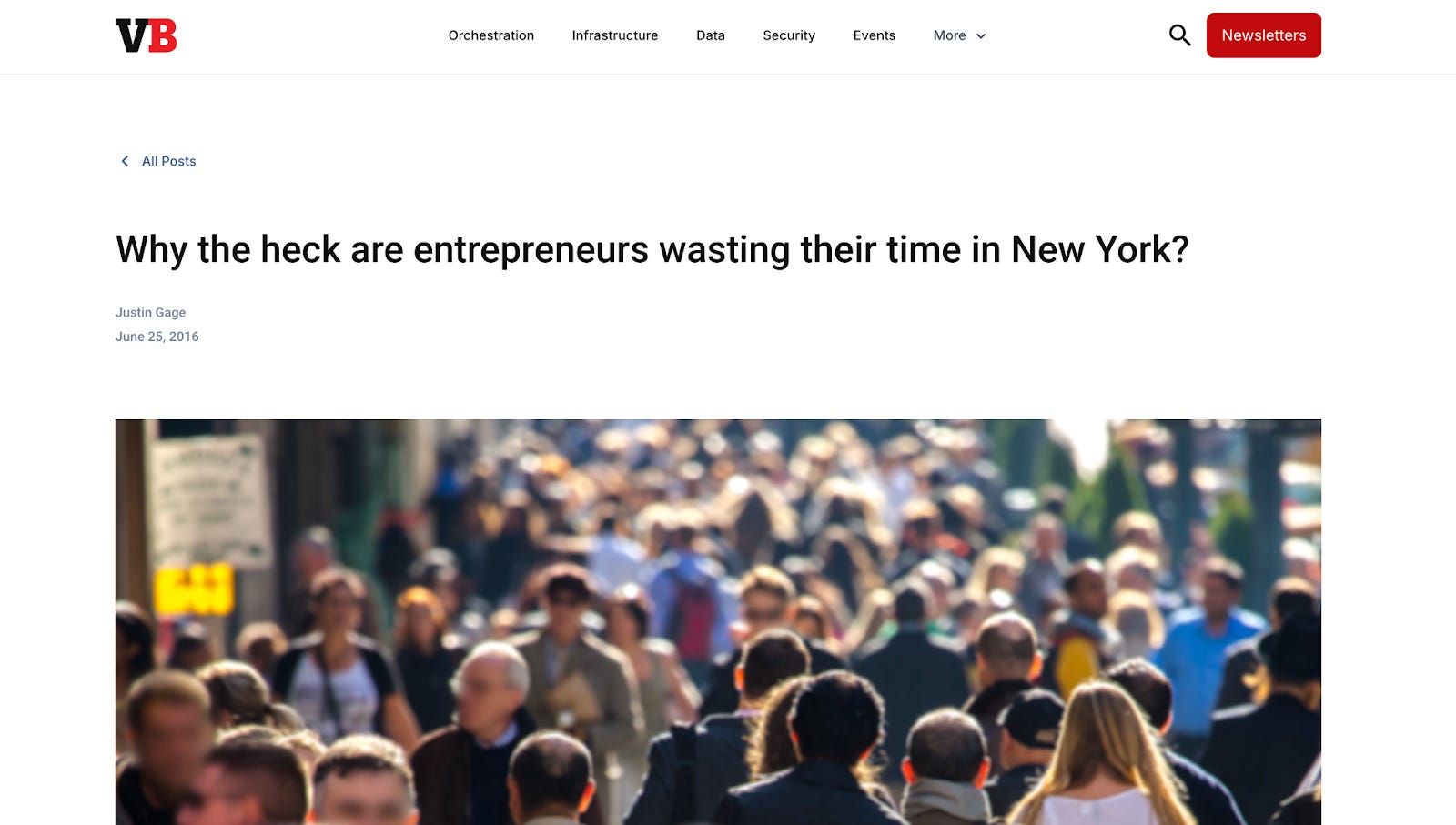
You can tell I was young because I was still afraid to curse on the internet.
After this I was off to the races. I ended up publishing several more pieces in VB, a few in CrunchbaseNews, and some private help for a few companies I had met (strangely, 2 out of 3 of them got acquired by Nike??). In fact, writing is what landed me my first startup job at Algorithmia. This post, which I wrote for and with their team (for free of course), was what got me in the door.
And then eventually writing became my career. At Algorithmia I just sat down and wrote blog posts for a year. Then after a brief detour at DigitalOcean to live out my fantasy of being a data scientist, I sat down at Retool and wrote blog posts for 2 years. Somewhere in the middle I started Technically, where I’ve been writing blog posts for like 6 years. Along the way were a few wins: tens of thousands of subscribers, reigns on the front page of Hacker News, and the occasional viral tweet.
I owe my entire career to writing, no two ways about it. It’s one of the core parts of my identity, and the thing I think I’m best at (though you’re free to disagree). And though I’ve got a VP title and more responsibility now, I’ll always be a writer at heart.
Act II, skepticism
I regale you with this narcissistic drivel to put you in my shoes and understand how I might have felt when the first version of ChatGPT came out. Everything was all wrong.
First, the vibes were just way off because the writing sucked. The only thing worse than no writing is bad writing. And I was used to dealing with bad writing, particularly from the agencies I had worked with at Retool that offshored technical tutorials to slop factories that charged a few cents a word and gave you exactly what you paid for. When you see profoundly bad writing you feel anger; knowledge that the person that created this didn’t care about it pretty much at all. The models invoked this emotion, even if it wasn’t their fault.
Early technologists face a perennial dilemma: release too early and cement permanent skepticism, or release too late and watch someone else beat you to it. Early ChatGPT was firmly in the first bucket. I believe the early wave alienated so many writers because of how crude the initial product was, passable to the typical tech worker but so obviously trash to anyone who wrote for a living.
Second were obvious ethical concerns. I don’t mean this in an objective sense (many of you know I have a tattoo of Sisyphus on my leg) but in a personal one; my own code of what felt right was clearly offended by these models. Are you really going to outsource your creative process to a model, goading it to produce the same bullshit it’s producing for everyone else, and completely deserting your soul in the process?
Then there’s the obvious problem, that these models were trained on the writing of me and everyone else who writes. Only sheer hubris would allow me to contend that my words in particular carried weight in the weights. But the fact remains that OpenAI trained these models on my and my fellow writers’ work, without our consent, and have paid us $0 in return (alas, I don’t work at the NYT). Whether you believe this is evil or not, the ethic-vibes of using it as a writer felt way off.
For these reasons and others, I didn’t use AI models at all for the first few years they were around…despite spending my whole career at technical companies. Didn’t want anything to do with them. Even to this day, I probably use AI tools less than you’d expect.
Act III, introspection
Over time, a few things changed.
First, the models got better. You could get output that wasn’t actively offensive and started to resemble something that might be useful to you at work. Getting rid of the knee-jerk anger reaction I’d developed to bad writing – like I mentioned, honed over work with many shitty agencies – played a big role in opening me up. These ChatGPT words weren’t good, but they weren’t so bad as to make you angry.
Second, through talks with friends, myself, my therapist, and whatever happens in my unconscious mind when the sandman comes, I was able to get more in touch with what exactly writing meant and what in particular was the creative process for me specifically.
When I write, what is the creative act?
Is the creative act the thinking about the format of the post, and how it’s organized? Is it the content itself? Is it the writing of the content, or the typing on the keyboard? Is it the editing? The sharing and publishing?
The answer is yes, these are all part of the creative act. There are all of these important scaffolds around the words themselves; the creative act is definitively not just the writing of words. Look no further than Robert Gottleib’s relationship with Robert Caro if you want to understand editing, for example, as the creative act. Writing is best viewed as a living ecosystem of process, some directed and some cyclic, all connected and imbuing the final product with a different piece of its eventual soul.
When I really introspect about why Technically had a modicum of success or why my technical writing was in demand, if I’m being really honest, it’s not really my words in the traditional sense. I don’t make the best jokes, my prose isn’t the most beautiful, I’m not the most witty, and I’m certainly not the best researched. When I read writers like Matt Levine, Father Karine, I think: these are good words. That’s not really my thing.
I think I just pick the right things to write about. My instinct for the right level of detail, the context a reader needs and doesn’t need, and when the story should start and end, is very good. Technically worked because I was more technical than most and less technical than most; I found a sweet spot that really worked for really smart, ambitious people who just weren’t technical but wanted to be.
This, by the way, is why I pretty much never edit my writing materially. Passing over particular word choice and flow is just not going to do much, that’s never been my strong point. The real work is in choosing what to write about, laying out the sections and their order, and deciding what the reader needs to know to know what you want them to know. I pretty much never agonize over words.
Act IV, acceptance
I regale you with this self-effeating tale because it explains why there are ways to use models that reinforce your creative process instead of outsourcing it. For me the words are not really the point, the structure and thought is; this is a great use case for AI models.
This is pretty much how I use AI for writing today, for the limited amount I use it. The hard part of writing (again, for me) is the upfront scaffolding work: what do I want to say, what order should it be in, what details do I need. How I actually articulate that is a fine task to give a model a shot at. In practice (part 2 of this post, forthcoming) this manifests itself in very detailed prompting and the use of personalized style guides.
I have had some decent success with this, but mostly in ghostwriting for other people. For my own writing, despite models getting better and better, I’m increasingly finding that I’d rather just do it myself. This post you’re reading now is a perfect example:
I dictated what I wanted to say in ~25 mins to my phone while I was in the car
I took the transcript, combined it with my style guide, and gave it to Claude
The output was completely unusable and made me sad
I ended up writing the entire post from scratch
I have said that AI will replace you at your job if you let it and I still believe this. If you use vanilla prompts, treat models as oracles instead of tools, and completely outsource your creative process to them, your bosses will eventually do so too, rendering you useless. For most people, it’s clear that there’s significant alpha in using models to help with writing.
For me though, for using my voice under my name saying something I want to say, I still like to do it the old fashioned way.