

What’s a Datacenter?
What actually goes on inside the buildings propping up the US economy.

If you know anything about the cloud or modern web apps, you’ve probably seen a diagram like this one:
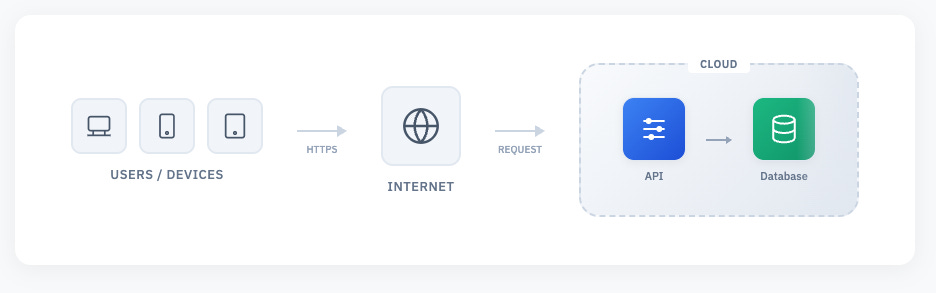
For most of us, even most engineers, this grey box is a sufficient level of detail on the datacenter, and that’s by design. Cloud service providers (CSPs) make it so you don’t need to know anything about the computers that serve your HTTP request or store your data. This is the fundamental value proposition of the cloud: you take care of the code, we’ll take care of the hosting.
But aren’t you curious?
Datacenters… So hot right now
Datacenters are the subject of renewed public attention, for better and for worse. On the bright side, datacenter investment is broadly holding up the US economy. A Harvard economist estimated that datacenter and related tech investment accounted for 92% of US GDP growth in the first half of 2025, despite being just 4% of total GDP.
On the other hand, all this datacenter construction has prompted major pushback from communities worried about their effect on the environment, utility availability, and property values. Over $64 billion in datacenter projects have been blocked or delayed due to local opposition. In Warrenton, Virginia, residents voted out every town council member who supported Amazon’s proposed datacenter. A nationwide poll found that only 44% of Americans would welcome a datacenter nearby, making them less popular than gas plants, wind farms, or even nuclear facilities.
So, what’s a datacenter?
When you search for the best Thai food near you, or post “happy brithday!” on your auntie’s Facebook wall, these requests are ultimately handled by a datacenter. The task you’ve set in motion by clicking the search button travels through the air, to your router, through a whole bunch of cables, to a computer in the datacenter that needs to actually retrieve Thai spots and then send those results back to you. These computers that do the heavy lifting behind the scenes, which are called servers, are the lifeblood of the datacenter. The datacenter is where thousands of servers that power your favorite application call home.
More than just pad see ew reviews flow through datacenters: critical time-sensitive information like bank transactions, visa applications, and medical records all rely on datacenter operations. When these critical centers of infrastructure have outages, businesses, institutions, and economies are hit hard. All this to say: keeping servers on, secure, and reliable is very important. Every aspect of the datacenter, its location, people, technology, and design, is in service of this goal. So let’s take a tour.
Getting there and getting in
You’ll probably need to drive to the datacenter, because datacenters are in the middle of nowhere. As we’ll learn in a bit, these operations depend on fiber access for fast networks, but also take up a ton of space, so cheap land is helpful. For this reason, datacenters are often on the outskirts of larger metros - think northern Virginia outside DC, and Oregon outside Portland.
Not just anyone is allowed into the buildings that run the economy. Modern datacenters employ biometric identification methods, a two-door “man-trap” to avoid anyone sneaking in behind you, a strict no phones / personal possessions policy, and the requirement that any guests be accompanied by staff at all times. With the price of GPUs these days, perhaps Ocean’s 18 will see Danny and co. get through all these mechanisms to steal a pocketful of chips.

Let’s get physical
In the main hall of the datacenter, the first thing you’ll notice will be the sound. A low but loud hum that comes from all sides at once. These are the mole people. Just kidding. These are the cooling fans! Computers do their best work at about the same temps that humans do - between 64 and 84 degrees Fahrenheit. This requires, among other things, a ton of fans. They blow cool air up from the ground to the front of the servers, and another fan blows hot air from the back of the servers out into the exhaust. The difference between the “cool aisle” and the “hot aisle” can be over 30 degrees.
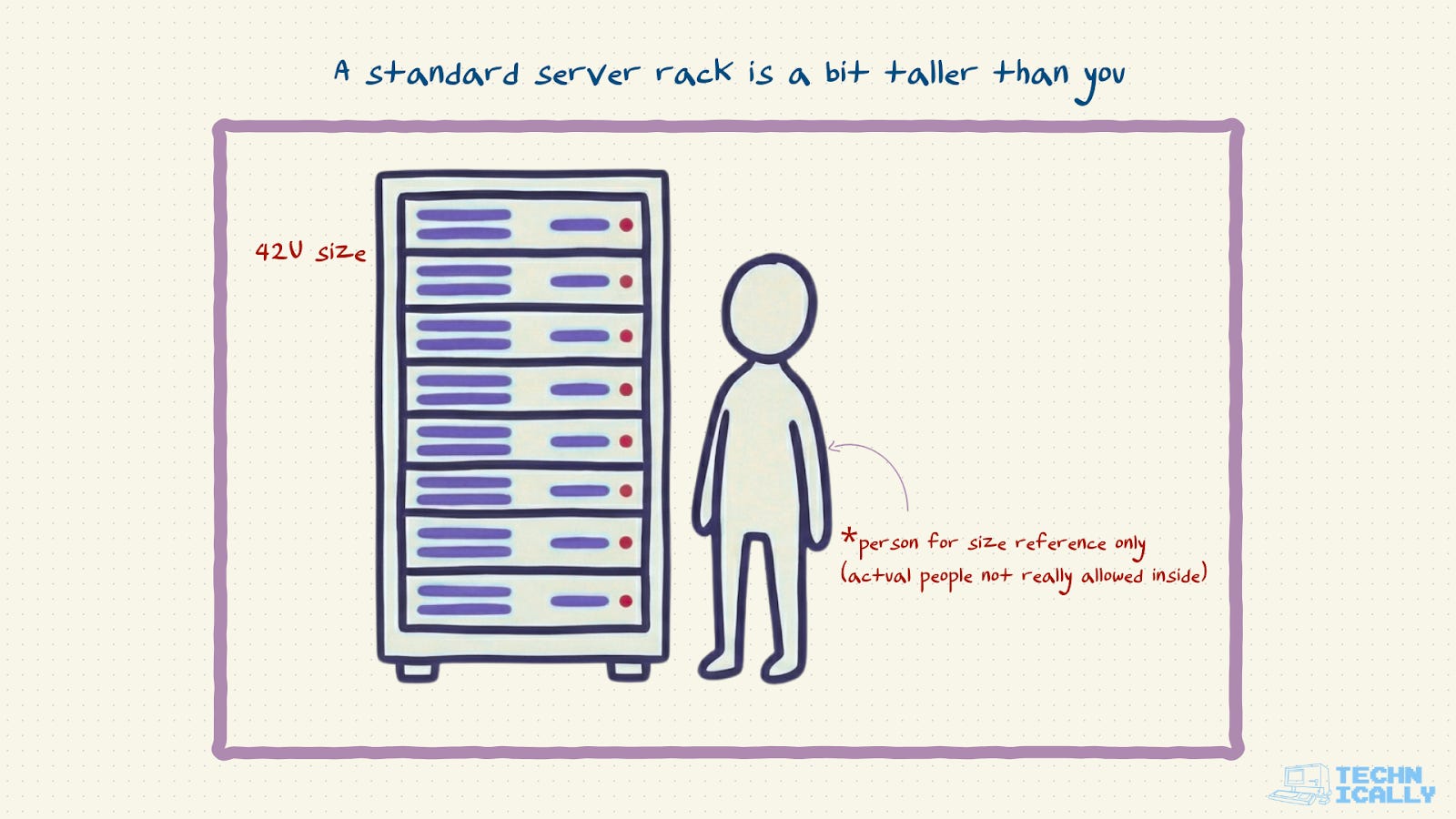
Looking around, you’ll see rows and rows of tall cabinets. In scale, these fall somewhere between library shelves and narrow streets. The cabinets themselves are about 6 feet tall and 2 feet wide, and they’re arranged in rows that can stretch hundreds of feet. This is where the servers live. But before we get to the servers themselves, let’s talk about how all of this is organized.
Servers are housed in cabinets called racks. A standard rack is 42U tall, “U” being the unit everyone uses, equal to 1.75 inches of vertical space. Do the math and you get about 73 inches, or just over 6 feet. The 42U standard exists for practical reasons: it’s tall enough to pack in a lot of compute, but short enough to fit through doors and elevators, and a technician can reach the top without a ladder.
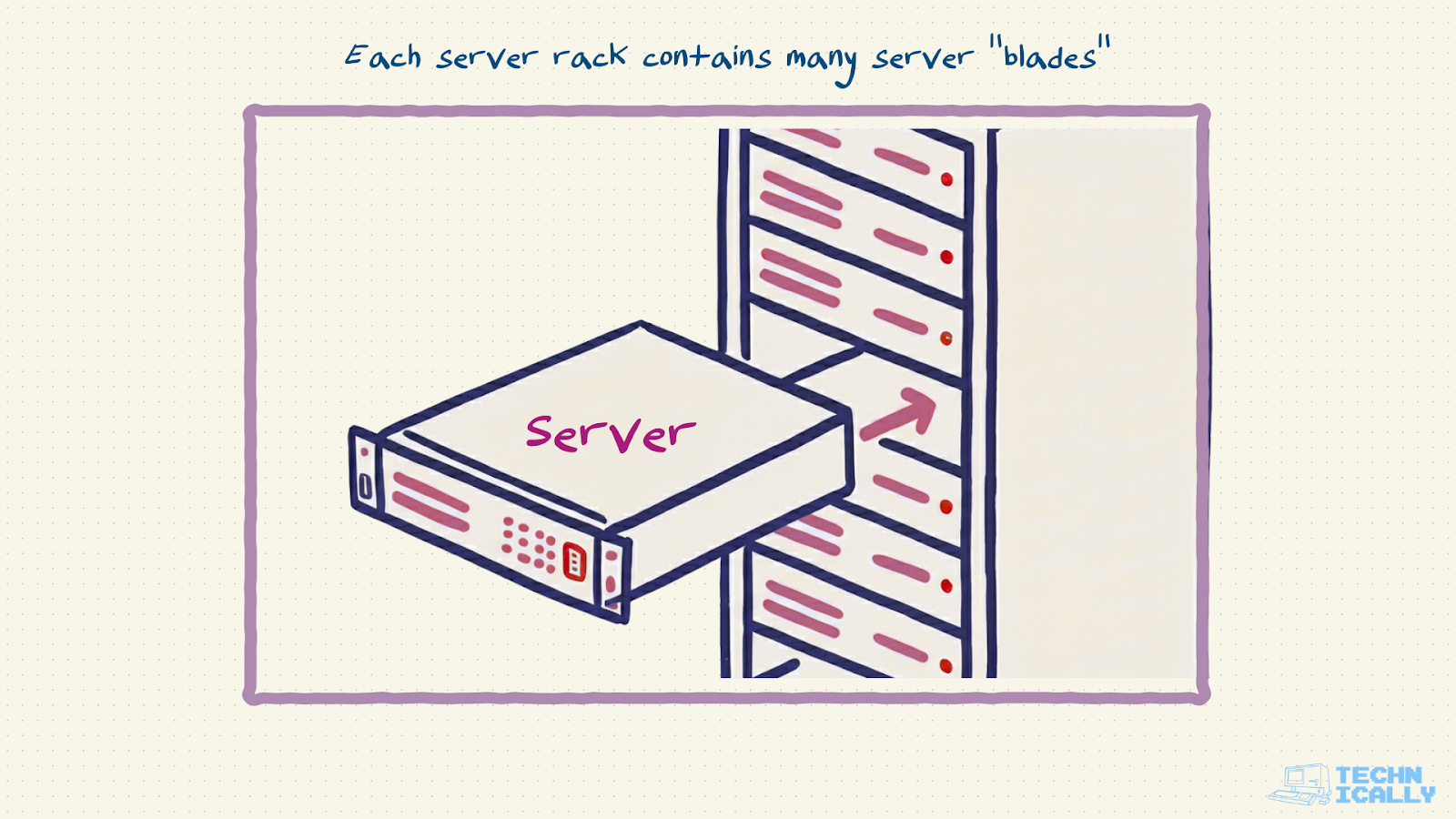
Inside a rack, you’ll find servers stacked like drawers. A typical server is 1U or 2U tall, so a single rack can hold somewhere between 20 and 42 servers, plus switches, power distribution, and cable management. The width is standardized at 19 inches (the actual mounting rails are 17.75 inches apart), which means any server from any manufacturer will slide into any rack. This interchangeability is the whole point, which we’ll get to in a second.

 | A guest post by
|