

What’s a Package Manager?
And why are AI labs like Anthropic + OpenAI buying them up?

Package managers have historically been an important, but kind of boring, aspect of software development. Recently though two large acquisitions, of Bun by Anthropic and of Astral by OpenAI, have prompted renewed interest in these little frameworks. Let’s take a look at what they are, and why billion-dollar frontier AI labs might be buying them up.
Intro to package management
The vast, vast majority of software, be it consumer apps like Snapchat and Strava, or B2B platforms like Salesforce and Workday, use open source software as building blocks. This is to say, they use code written and made public by other people to save themselves time when developing their own applications.
A classic example of a use case for leveraging open source code is if your app has anything to do with time, such as displaying the date and time to a user. Time is surprisingly complex: what time zone are users in, are they in daylight savings, do you want to display the day of the week as well? You could code up all this logic yourself, but it’s much easier to use code someone else already wrote to do this.
The world of package managers emerges when you ask: how do you actually use someone else’s code?
One naive way might be copy-pasting code from someone else’s app or website into your own codebase, line for line. This would work, but is very inefficient. What happens if the author makes changes? What if there’s a security vulnerability discovered down the road?
For these reasons and more, the most common way that developers of open source software distribute their code is by bundling it into packages and publishing them for the world to use via a package manager. You can think of a package as a nice wrapper around the code that someone has authored, boxing up your little (or a lot) bit of code nicely so you can ship it to others without things getting messed up.
🚨 Confusion Alert 🚨
The terms package, library, module, and framework are used mostly interchangeably in the industry, for simplicity, I’ll stick to package here.
Package managers are programs that deal with the logistics of these “packages” of code: in particular, fetching and installing these open-source software packages. They are used almost anywhere people (or robots) write, test, or run code. The key elements of a package management system are the package manager and the package registry. Let’s quickly review how they work.
If I’m a developer starting a new project and I want to use someone else’s code for something (like handling dates), one of the first things I’m going to do is ensure I have a package manager installed on my system. The package manager makes it extremely easy to install the packages that I need. Each language maintains one or more official package manager, such as pip for Python, and npm for Javascript.
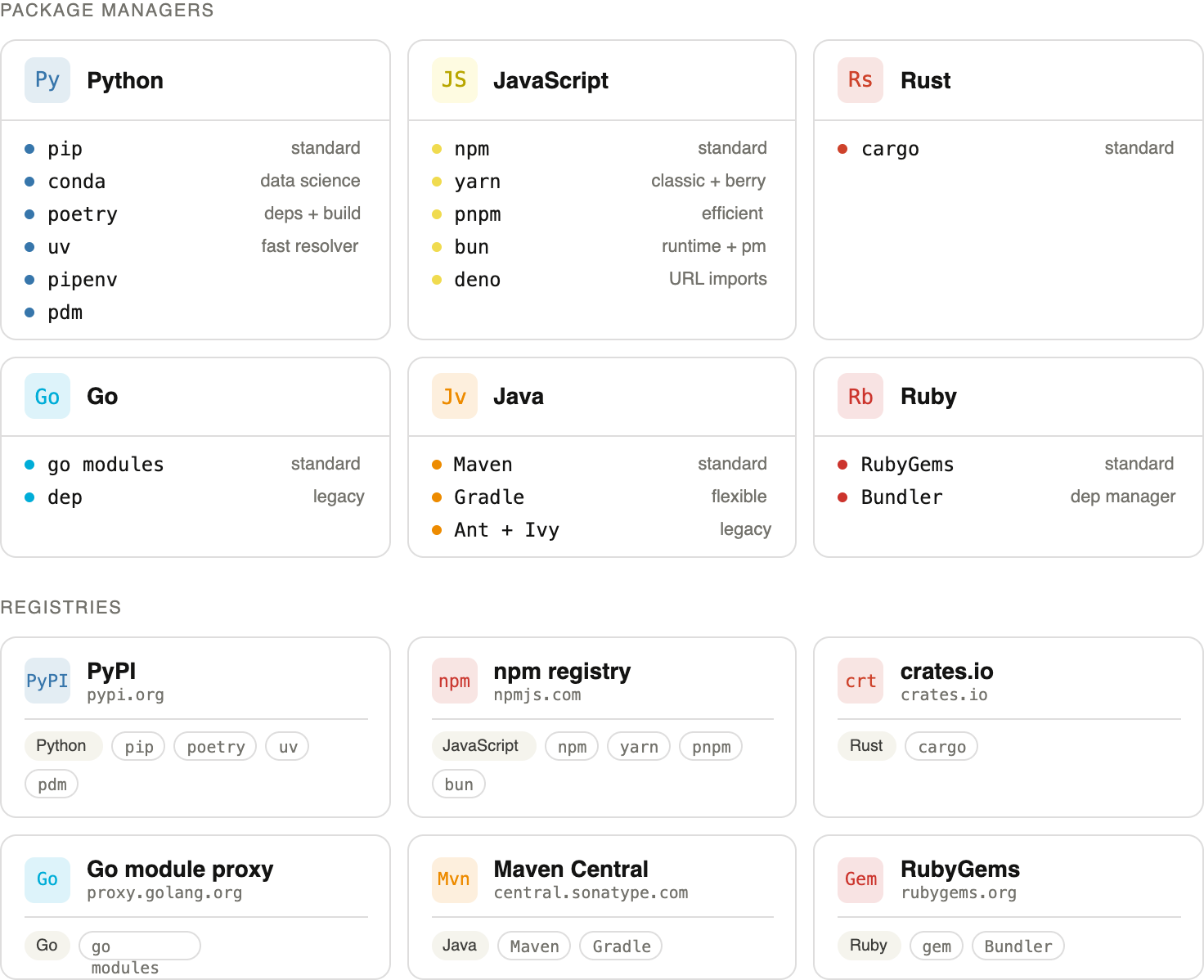
For the example where I’m coding up an app where I need to display time to my user, if I was building in Python I’d use pip by opening up my terminal and typing pip install pendulum (pendulum is the package name). The package manager does a few things:
First, the package manager checks my system to see if pendulum is installed already. If it is, fantastic, it does nothing. If it is not, it goes out and downloads the package. But where does it go to get the package? It goes to the registry.
The package registry is a public, trusted repository of open source software packages on the internet. Each language maintains one or more official registries, such as PyPI (Python Package Index) for Python, not to be confused with pip, and the npm registry for JavaScript.
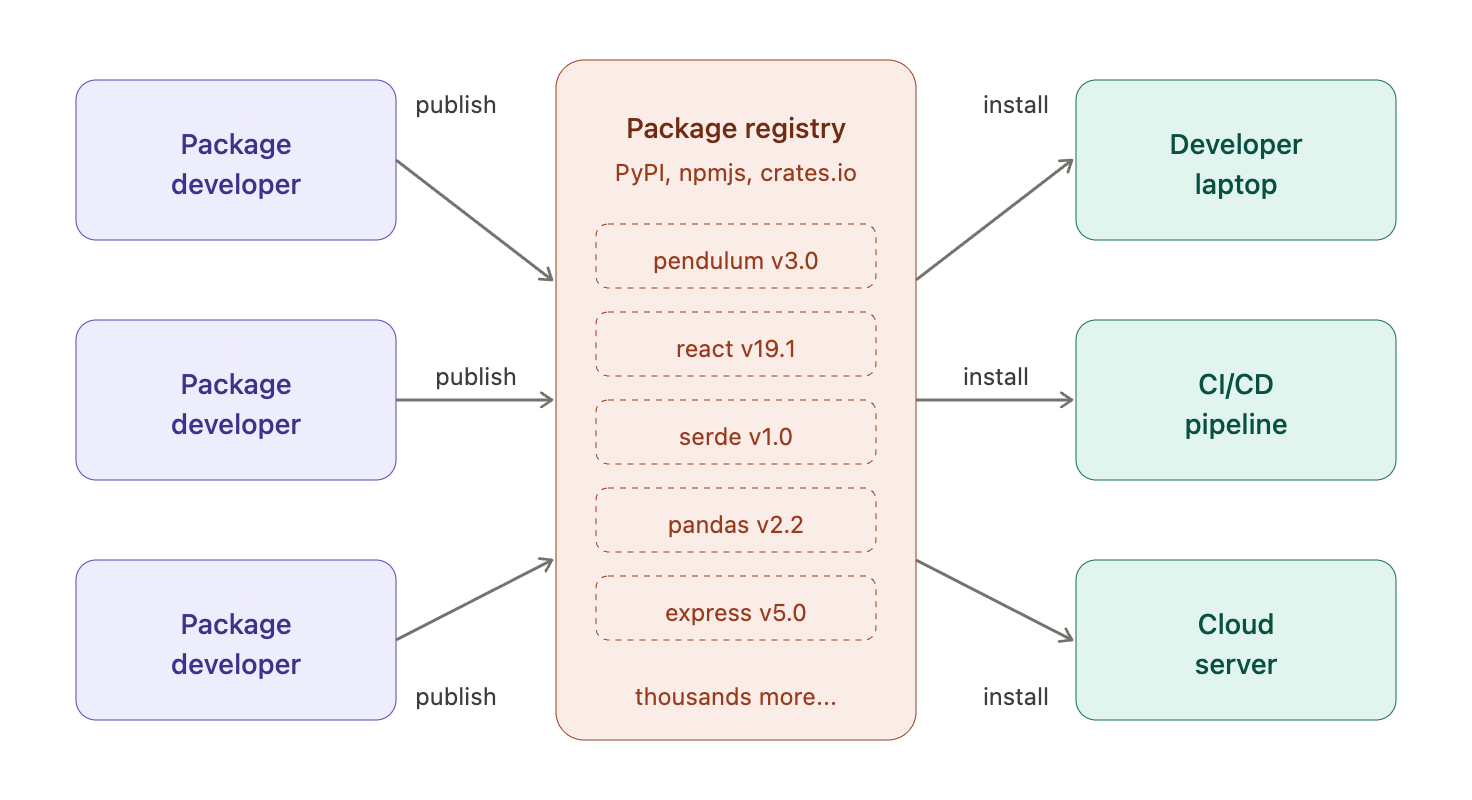
You can think of the registry as the warehouse where all of the boxed software goes to be shipped out. The authors of the software are (ideally) constantly uploading new and improved versions of their packages so users like you can benefit from the great wheels of progress.
This general process of ensuring I have the packages I need is referred to as dependency resolution – a dependency just means a package that your software needs in order to run – and it’s the core job of the package manager. And it’s a full-time job: as I code up more features, my dependencies will change, and the package manager needs to make sure what I need is installed at all times, and what I no longer need is purged from the system.
Over time, many package managers grew beyond just fetching code. See, going from code to real running software requires a few other steps. For example, after code is written and external packages are installed, something called a compiler or bundler needs to translate that code into a language that’s readable by the machines. After that, a different program actually needs to run the code, called the runtime. At least that’s how it was for a long time — different tools for different stages of the pipeline.
But newer tools like Bun in the JavaScript world started collapsing this entire toolchain into one fast program that handles everything. This bundling is important context for understanding what AI labs actually bought, which we’ll get to shortly.
The thing I want you to know is that for the entirety of my time building software, and for decades before that, the package manager was a thing you used manually, slowly, and pretty infrequently. Starting or pulling a new project, updating a package, or running some tests locally. It was not software that anyone loved or waxed poetic about, it was just a thing you had to do.
This is because coding — making your software do what you want it to do by typing out instructions — takes a long time when humans do it. For human engineers, package management only has to be as fast as humans can decide what packages they need and can use them in their development cycle. Until recently, this was fine, because humans were the only entities that could write code.
And then came the agents
LLMs, on the other hand, can generate code really quickly. AI-powered coding agents can now take a loose set of requirements for a feature or whole app, plan the implementation, and then code it up across a massively parallel fleet of agents. And though the speed at which they can generate code is fast, they still need to run that code: each member of this fleet needs to resolve package dependencies, install packages in isolated environments, run tests and code, and clean up after themselves after they’re done. Just like humans do.
Even AI features geared toward non-developers increasingly require the ability to quickly write and run code. For example, when I ask Claude to produce a Word document, it installs an open-source JavaScript package called docx-js, writes code that uses that package to produce a document, and runs that code all within an isolated environment in the cloud.
So, using package managers went from a slow thing humans did once in a while to a thing that needs to happen tens or hundreds of times a minute when it’s agents writing the code. Where code runs went from a permanent thing I’d think about once per project, to something more ephemeral that needs to be rapidly spun up and torn down many times an hour.
What this means is that package managers are now critical infrastructure for AI products. They’re in the “hot path”, as we say in the biz. Every time Claude Code produces a file, or Codex writes and tests a function, package managers and runtimes are doing work on every single invocation. If they’re slow, the product feels slow. If they break, the product breaks.
Anthropic and OpenAI both have whole suites of products that involve agentic coding, from terminal-based offerings like Claude Code and Codex to their desktop apps and more. I believe that the folks at these labs realized early on that a big bottleneck in the quality of their products was going to be the sluggish package manager ecosystem. So they bought the best ones out there. And the tools they bought were the ones that had already grown beyond just package management into all-in-one toolchains that handle package management, building, and code execution.

 | A guest post by
|