

Understand AI or die trying
Knowing how AI works might just stop it from replacing you.

TL;DR: we’re announcing the AI Reference, the best, fastest, and free-est way to get smart on the fundamentals behind AI models like RAG, RLHF, context, and pre-training. It’s totally free and you can dive in here.
90s kids will without a doubt remember these:

Behold, the Magic Eight Ball™.
The eight ball was an answer machine. You’d ask a question, turn over the eight ball, and get a random response. Don’t count on it. My sources say no. It is decidedly so. Signs point to yes!
Trying to decide if you should call her? Ask the eight ball. Wondering if you’ll ever get that job interview? Eight ball. Unsure about which college you should go to? You should probably ask your advi…nope, eight ball. This plastic orb of whimsical wonder was the oracle of an entire generation – my generation – injecting a little random levity into what was an uncertain time in life for many of us.
The idea and technology behind the eight ball were originally created by Albert C. Carter in the mid 1940s. Inspired by his clairvoyant mother, Carter patented (yes) a series of crystal ball like fortune telling devices, all of which went nowhere. That was until 1950, when Chicago’s Brunswick Billiards Company was looking for a promotional toy of sorts…and the rest was history.
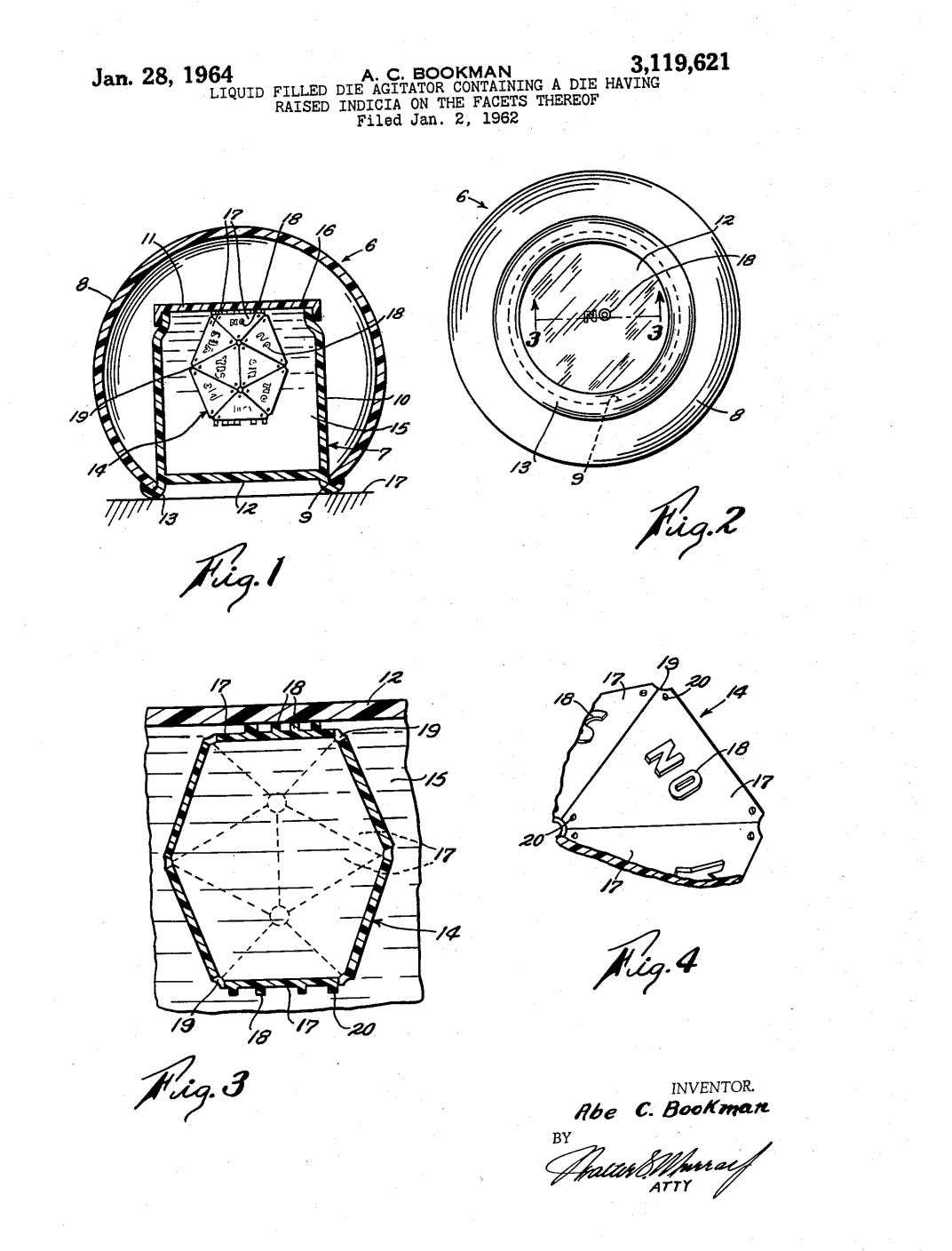
The way it works is simple. Inside the eight ball lies a canister full of dark blue liquid, in which is suspended a plastic multi-faceted die (usually 20 sides). When you turn over1 the eight ball, the die floats up and lands on one side, showing you a decidedly random message. The visage became so popular that it even made its way into high fashion, if you can call it that.

The thing about the eight ball is that it’s fun. Like opening a fortune cookie and peeking inside at the little white flag, you couldn’t help but chuckle at how right or how wrong it really was. The eight ball is a gimmick. It’s a good bit.
On the flip side, there were people who actually did take the eight ball’s response to heart. And it was precisely the randomness inherent in the eight ball that they respected. If you needed a new direction, if the sum of your life choices had led you to somewhere uncertain, or even if you just couldn’t decide between the 10 or 20 piece McNuggets…well, maybe you wanted to just leave it up to the universe this time.
A fundamental philosophy was shared between the eight ball ignorers and the eight ball listeners. You know how the eight ball worked, and that’s exactly why you used it. Our understanding of the device’s mechanism directly informs our perception of the output. We cannot understand, or make use of, a mechanized response without knowing how the response was formed.
AI will only take your job if you let it
We have magic eight balls today, and they’re called LLMs. They are completely transforming every white collar (hello) worker’s lives and will continue to do so as they get better and better. The quality of LLM responses is not just impressive, it’s not just useful, but it’s getting a lot better incredibly quickly. Ergo, the question on everyone’s mind seems to be: will these take my job?
In my mind the answer is: AI will only take your job if you let it. If you assume the position of luddite and shun these models, trusting your own (manual) work above the AI, you will likely at some point get automated. If you offload too much to the model, carelessly prompting and pasting while letting the AI do all of the work, you will likely at some point get automated. But, if you treat the model as a powerful tool, to be wielded as a reflection of your own taste and soul, you will not only not get automated, you will be able to accomplish orders of magnitude more than you ever dreamed possible.
But this is where the problem lies: too many people are incredibly lazy AI users. They write vanilla prompts, they fail to scope the problem properly, they don’t understand how to use context, and they take the first response without iteration. If you treated our last generation of tools like this – whether it’s Hubspot as a marketer or VSCode as a developer – you’d get nowhere. And if your usage of AI is this overly simplistic, it’s only a matter of time before someone more senior than you at work realizes they can run the same basic prompts as you can.
If clever, personalized usage of AI tools is so important to our success, why do so many people not do it? Well to start, nobody has any fucking clue how these models work. They think that pre-training is when you teach your child to use the toilet. RLHF, RAG, these are acronyms of mystery. To most, Machine Learning might as well be organic chemistry.
You obviously don’t need to be a computer scientist to use an AI model. But without any fundamental understanding of what they even are, you will not be able to use them productively. If you want to use these models well – and avoid being used by them – you need to understand the basics of how they work:
If you want to prompt well with good context, you need to understand what context is, how models interpret text, and what a context window limit allows you.
If you want to apply AI with good taste to the right problems, you need to understand how the word-guessing LLM architecture works and what it’s good or bad at.
If you want to vibe code an app that actually lasts, you need to understand chains of thought, why models work better with plans, and how to use the system prompt to your advantage.
Another reason this is important is that models get things wrong, all the time. It’s called hallucinating and much of it goes completely undetected because of how confidently models respond to prompts (Oren Etzioni phrased it as “a very impressive-sounding answer that’s just dead wrong”). And nowhere is this more visible than in the courtroom, where there are already hundreds of cases of legal decisions where GenAI produced hallucinated content.
Unfortunately, it’s really quite hard to get smart on AI. This stuff is highly technical, it’s complicated, and the people building it aren’t really prioritizing education of the non-elites. There are 100 newsletters out there covering the latest developments in AI…but how many stop to tell you how a neural network works? Hell, I majored in Data Science and I still find myself needing fairly extensive research to write intelligently about whatever the latest in Claude is.
Meanwhile, models are getting more and more complex. Unlike most of the rest of software, AI is a research discipline. And the speed at which said research makes it into product is unprecedented. To know what makes GPT-5 different from GPT-4 is not as simple as reading a few lines from a release blog post. Today’s AI model is actually an amalgamation of several different models that would each have been groundbreaking just a few years ago. And I’m sure in a few years today’s state of the art will be primitive.
Sometimes it can just feel like this technology is simply beyond the average person’s ability to understand. And yet, it has never been more important to understand it. Which way, western technology user?
Announcing the Technically AI Reference
I’ve spent the last 5 years writing Technically, trying to make software and AI easier to understand. Over half a decade, 100+ articles, and 75K+ subscribers later, I believe I’ve done good work towards making it easier for the average joe to understand what’s going on. You can read Technically to understand what an API is, how to swim in a data lake, or what Stripe actually does.
The same desperately needs to be done for AI, and soon. I promise you I’m writing as fast as I can. And this is all why I’m excited to announce our newest release, the AI Reference. It is without a doubt the fastest, easiest, and free-est way to get smart on AI.
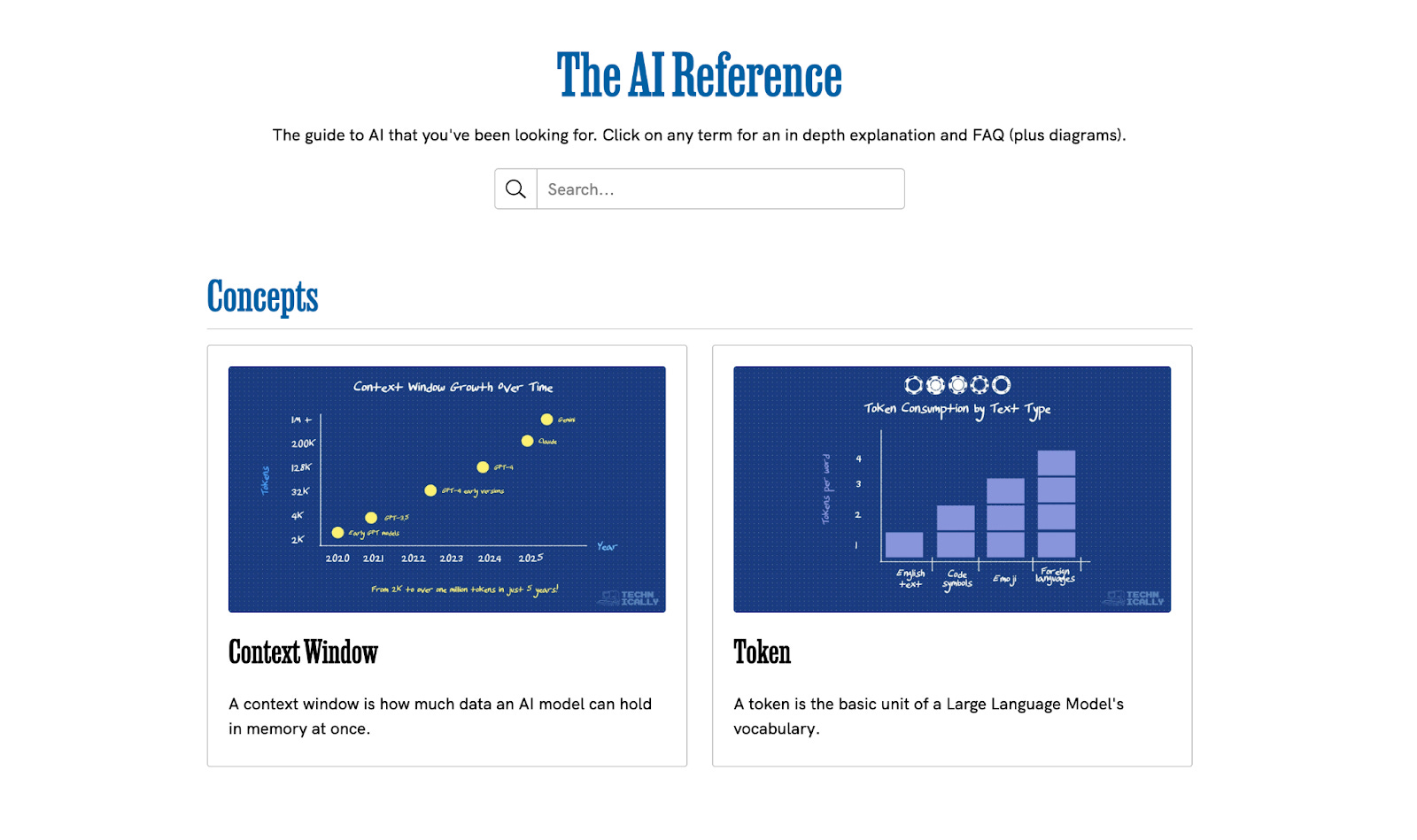
You can read about:
…and dozens more
Each concept has a basic explainer, common questions answered, and some really nice graphics that accompany you on your learning journey.
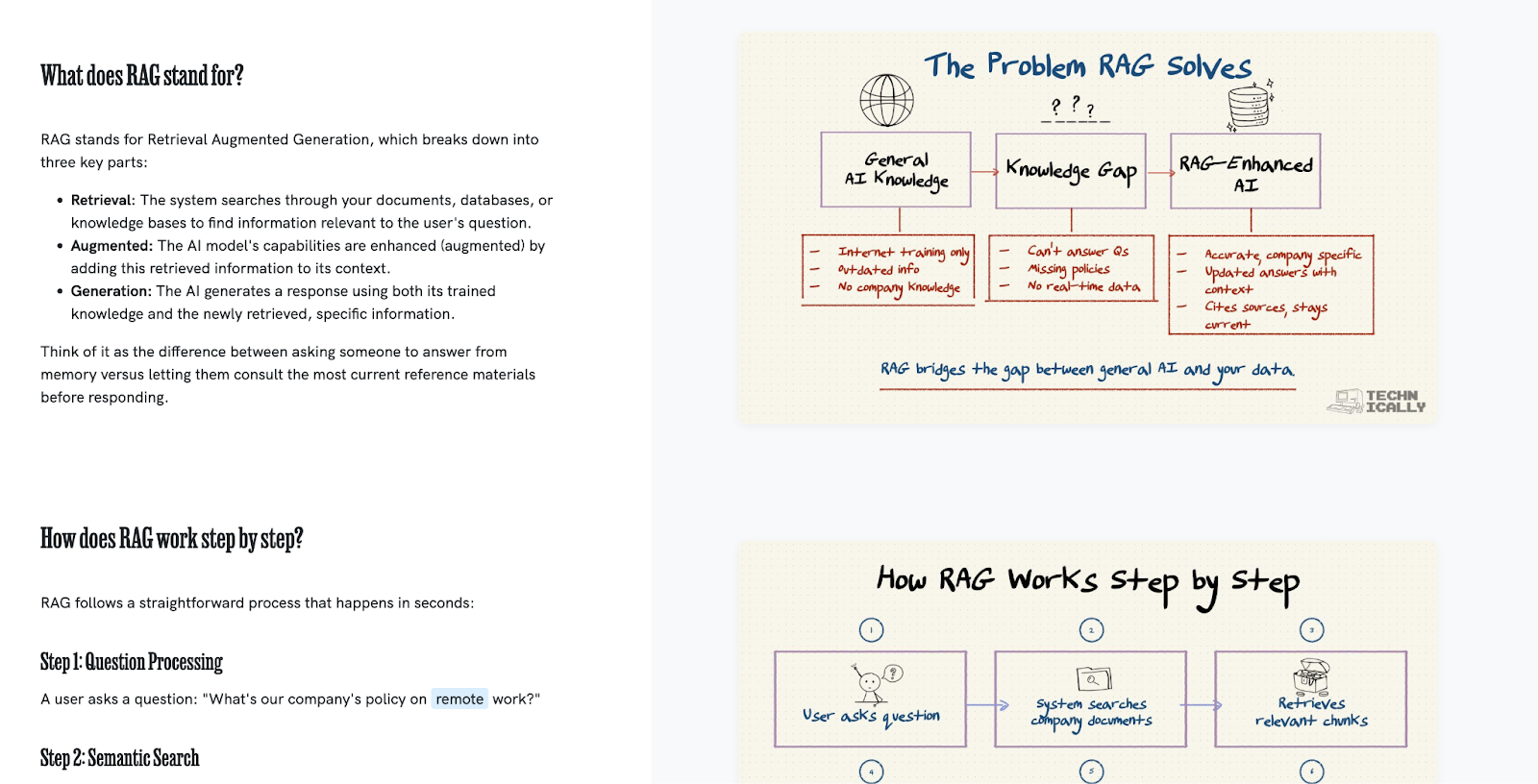
Like I said this thing is completely free, you can just peruse at your own leisure – although if you’d like to send me money that is fine too. We’ll be constantly updating and adding to it – respond to this email if you have any topic suggestions.
And remember the ancient wisdom of Curtis James Jackson III: “Understand AI or die trying.”
Apparently you aren’t supposed to shake it, because that sometimes creates undesired bubbling.
Hell yeah, love the magic 8 ball reference, i'm making a snarky Magic 8 Ball for PMs, https://pm8ball.com
“Today’s AI model is actually an amalgamation of several different models that would each have been groundbreaking just a few years ago. And I’m sure in a few years today’s state of the art will be primitive.”
This was an important highlight. The newer models are an abstraction from these SaaS providers, not simple 1 new FM.